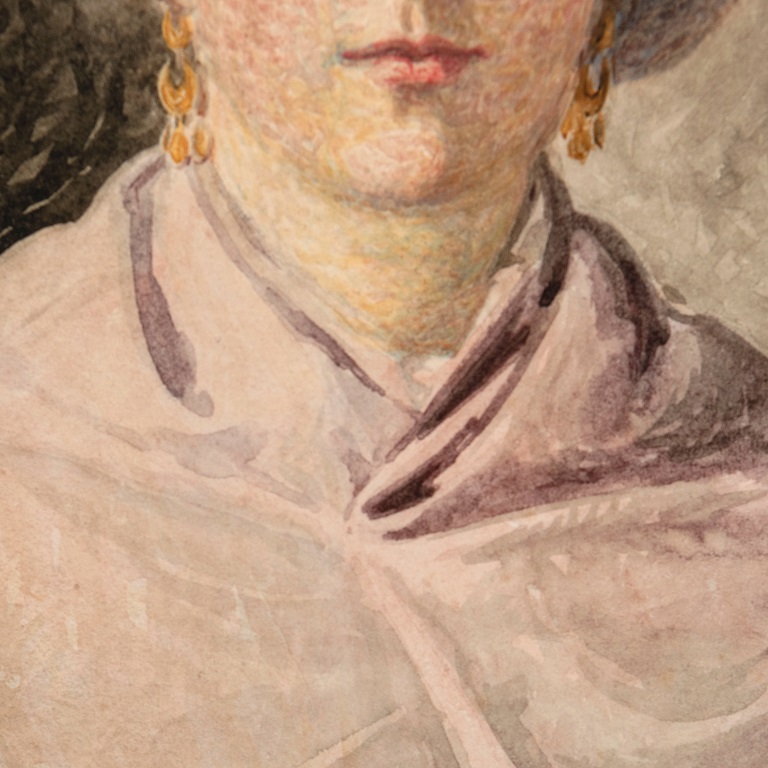
Watercolour portrait by William Henry Hunt, England circa 1950 (Out of Stock)
£2,000
SKU: C516
Start Date (circa): 1950
Medium: Water colour on paper
Signed lower left,Inscribed and labelled on the back board
Height: 21.5
Width: 13
Length: 3
Current condition: Excellent Condition
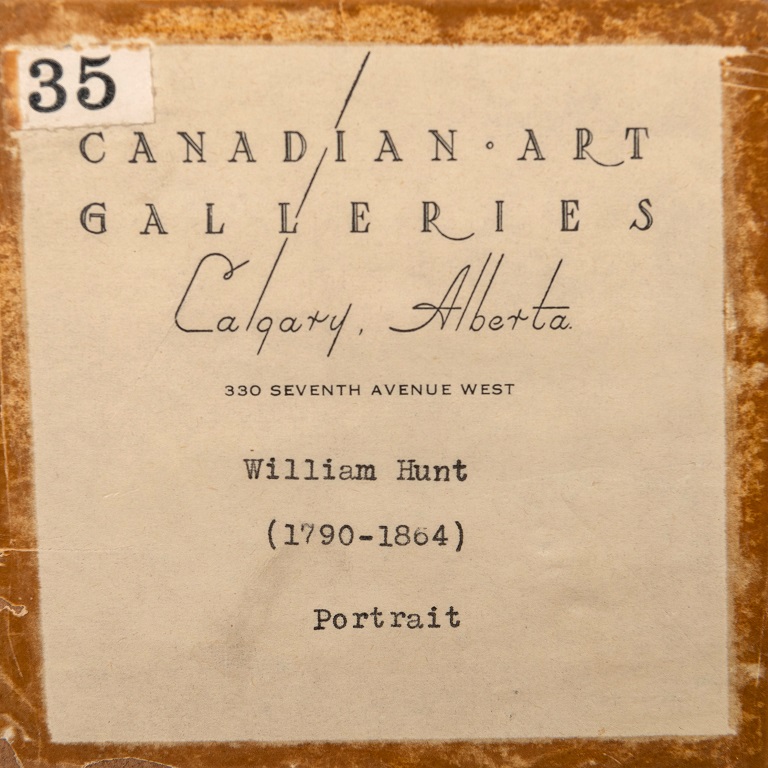
Provenance: Canada, Alberta, Canadian Art Galleries; J.F.Baron Union Tractor Company; USA, Collection of Nicky Wernick; London, The MAAS Gallery Ltd
Literature: Simon Fenwick; ‘Hunt, William Henry (1790-1864), H C G Matthew and Brian Harrison (eds), Oxford Dictionary of National Biography, Oxford University Press, 2004, vol 28, pages 878-880; Tom Jones, William Henry Hunt, 1790-1864, Wolverhampton Art Gallery, 1981; Scott Wi
Country: England
William Henry Hunt (1790-1864 ).
Lady in a Feathered Hat
Signed lower left,Inscribed and labelled on the back board
Watercolour
21.5 cm high x 13 cm wide
Prov; Canada, Alberta, Canadian Art Galleries; J.F.Baron (Union TYractor Company; USA, Collection of Nicky Wernick; London, The MAAS Gallery Ltd
William Henry Hunt, OWS (1790-1864)
William Henry Hunt was one of the most distinctive and influential of early Victorian watercolourists, who became synonymous with his naturalistic still life compositions executed in detailed stippling.
The son of a tin-plate worker and japanner, William Henry Hunt was baptised in London on 28 March 1790, and grew up at 8 Old Belton Street (now Endell Street), Covent Garden. As a result of his deformed legs and stunted growth, he was encouraged by his parents to pursue a career in art, and at the age of 16 he was placed with John Varley (living with him for a time at 18 Broad Street, Golden Square). There he made friends with William Mulready and John Linnell; Linnell and Hunt exerted a positive influence on each others work and made a number of sketching tours together in Southern England. While still a pupil of Varley, he began to exhibit at the Royal Academy of Arts (1807-25) and spent a short time in the Royal Academy Schools (1808- 09), during which he helped to re-decorate Drury Lane Theatre. His earliest important private patrons were the Duke of Devonshire and the Earl of Essex, who respectively commissioned drawings of the staterooms at Chatsworth and and the Earl of Essex, who respectively commissioned drawings of the staterooms at Chatsworth and Cassiobury.
It was at the latter place that he met Dr Monro, who then employed him in his informal academy.
By 1815, Hunt had established himself as an independent architectural and landscape painter, working in the eighteenth-century manner in pen and wash. He first exhibited with the Society of Painters in Water Colours during its phase as the Society of Painters in Oil and Water-Colours, and became an associate in 1824, and a full member two years later. In 1822, he moved to 36 Brownlow Street, Drury Lane, and in 1825 to 6 Marchmont Street, Brunswick Square. For a number of years, he wintered in Hastings, Sussex.
By this time, Hunt was turning to genre scenes and still life compositions, which he depicted with a newfound meticulousness. In these works, he was able to create fine atmospheric detail by building up coloured tints in hatch and stipple over a ground of white bodycolour. In 1830, he exhibited his first still life containing details of nature against a mossy bank, and became so well known for the type that he was soon dubbed ‘Birds Nest Hunt. However, he also painted a number of figures, some being humorous rustics, while others were set in candlelit interiors.
On 13 September 1830, Hunt married his 18 year old cousin, Sarah Holloway, the daughter of a farmer and miller in Bramley, Hampshire. A daughter was born in 1832. In 1845, they moved to 62 Stanhope Street, Hampstead Road, London and, from 1851, took a second home at Park Gate, Bramley.
Hunts approach to picture making proved very popular with both oil and watercolour painters, and became even more influential through the advocacy of John Ruskin. Hunt gave Ruskin lessons between 1854 and 1861, and in turn Ruskin recommended study of his work in The Elements of Drawing (1857) and Notes on Prout and Hunt (1879).
In the 1850s, Hunt developed an international reputation, being awarded a certificate of merit at the Paris Universal Exhibition of 1855, and becoming an honorary member of the Koninklijke Academie van Beeldende Kunsten in Amsterdam in the following year. In 1857, his work was well represented in the Manchester Art Treasures Exhibition.
Hunt died of a stroke at home in London on 10 February 1864. The contents of his studio were sold at Christie, Manson and Woods on 16 and 17 May 1864.
His manner of painting still life subjects was continued by John Sherrin (1819-1896), William Hull (1820-1880), John Jessop Hardwick (1831-1917), William Hough (active 1857-1894) and Thomas Collier (1840-1891).
His work is represented in numerous public collections, including the British Museum and the V&A; and Yale Center for British Art (New Haven).