How did your childhood influence your art?
My childhood spanned the 1940s/1950's and so my main influences would have been the books of Just William, Biggles, and the Eagle comic. Dick Barton Special Agent on the radio and Saturday morning pictures are still very clear and the theme tune for Dick Barton takes me back immediately.
I admit that there is no great artistic influence there but I always had the ability to draw and where that came from I have no idea. One of my earliest memories is waiting for the weekly cheese ration to be unwrapped so I could get hold of the paper before it was thrown away. I”d then spread it out on the floor to get rid of the creases, find a pencil and just lose myself in a different time and space. I had no interest in colour or paint – too much bother and messy – so all my efforts went into the drawing. Both my grandparents had original paintings that I remember well, but at the time were of no great interest to me.
What inspires you?
Even before I became an artist, I enjoyed looking at work that appealed to me, trying to work out how it had been produced; how layers of paint had been applied; the quality of the brushwork and so on. I think that trying to work it out was what attracted me. I suppose that I”m inspired to achieve as high a quality in my work as I can. I don”t want to invest time in a wall decoration. I want to create something – to use a modern term – “that has legs”. Something of quality that will last.
Did you always want to be an artist?
I became an artist more by accident and necessity rather than by design as I didn”t have any ambition to be an artist. It was an established fact that when I left school at 15, I would work in the family business and I had no reason to think beyond that. There came a time when the business was compulsorily purchased by the council for redevelopment. My parents wanted to retire and as I had no interest in continuing the business – and much to their dismay – I found myself out of work.
It was difficult to travel abroad during the late 1960″s as there were financial restrictions in place, but I decided to visit relatives in New Zealand anyway. I always had a small sketch book with me, so during my travels – which took me across Russia, Japan, the Far East and Australia. I had plenty of opportunity to make drawings. I stayed in New Zealand, working as a carpet layer, long enough to earn enough money to make my way to South America and then travelling overland to Central America, Mexico and the USA. I zigged zagged across America courtesy of Greyhound buses and when I eventually arrived back in the UK at Heathrow, I was penniless!
I quickly found work in a local furniture shop, but in my spare time started looking at the drawings and sketches I had made on my travels. I had made colour notes on the drawings so my next step was to buy some tubes of paint. The results were acceptable and a local gallery saw some merit in the work. They started selling on a regular basis so I gave up my job in the furniture shop and suddenly I was an artist.
What's the best thing about being an artist?
The lifestyle of an artist appeals to me on many levels. I was once told it is a very selfish occupation, which of course it is. One must have an ego to think that anyone is interested in what you produce. Of course, there is satisfaction in the work but it has also given me and my wife Rosemary the opportunity to meet some very interesting people from different walks of life and to visit some very exceptional places. It also allows me to enjoy the ability to immerse myself in a world of my own making, often becoming totally unaware of time and the frustrations of modern life. Who could ask for more?
Do you have an essential philosophy that guides you in your creative expression?
If I like it, I”ll paint it. If I don”t, I won”t.
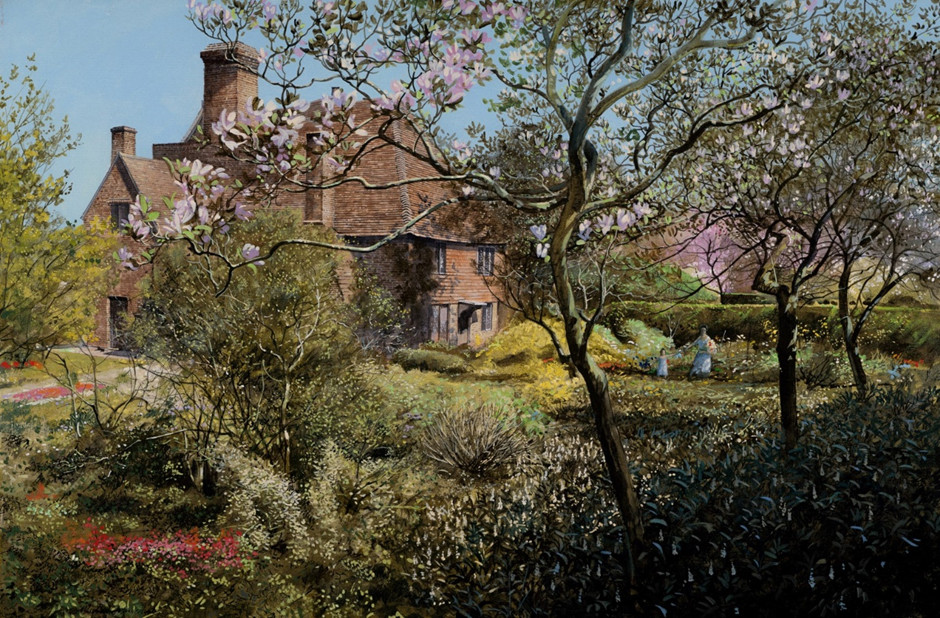
I am essentially a topographical artist. I like to record things and places that appeal to me or that others find interesting. Over the years I”ve had some very unusual commissions. I don”t have any messages, emotions or philosophies that I wish to burden others with – or myself!
What personality trait do you have that has been most helpful in your art career?
Determination. Tunnel vision. Routine. Not necessarily in that order.
What accomplishment are you most proud of and why?
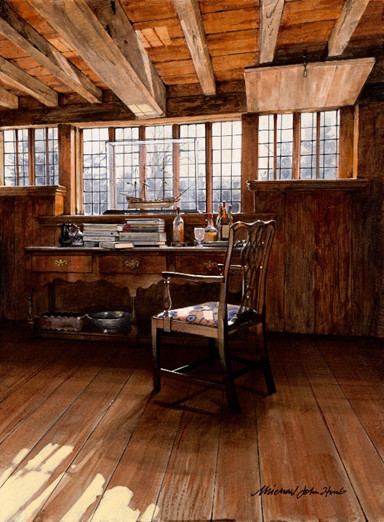
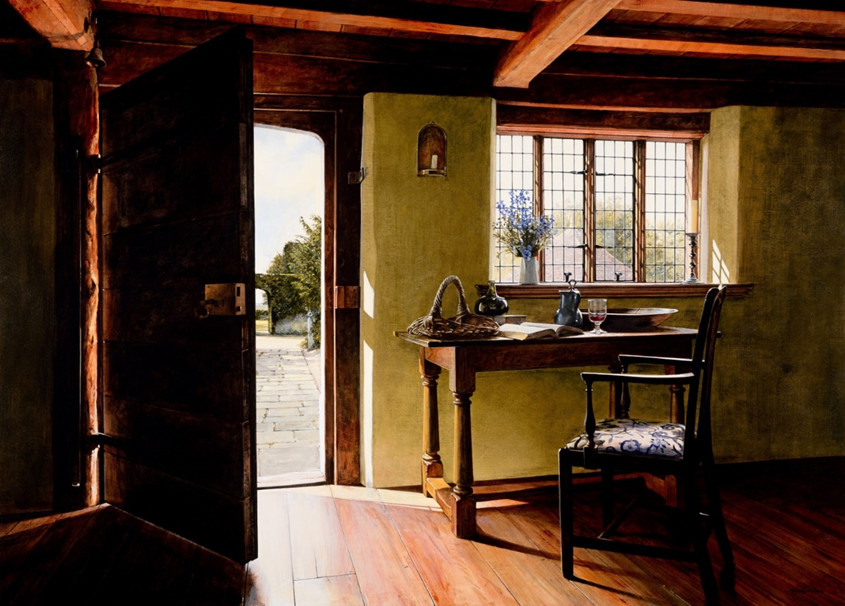
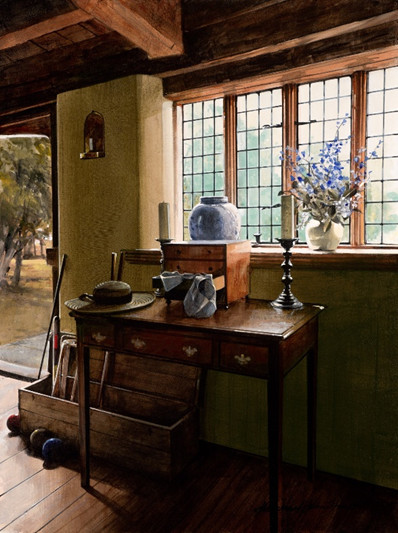
Through invitation, my association with two prestigious American Museums that both have collections of the very best examples of early American Colonial Interiors. I have some 160 paintings that form a unique, unparalleled collection of the genre.
What advice would you give to your younger self?
I should have taken my ability to draw more seriously rather than just as an enjoyable pastime.
Which artists are you most influenced by?
As previously mentioned, I have always enjoyed looking at paintings and I respect any artist who is a good draughtsman. There would be a long list of artists whom I admire – from the Golden Age of Dutch painters to American illustrators; the drawings of Richard Parkes Bonington; the topographical views of Canaletto and his nephew Bellotto; Turner”s wonderful use of colour and the evocative paintings of Hammershoi. Many, many influences.
What is your most important artist tool? Is there something you can't live without in your studio?
Brushes come and go but I do have a palette knife that I”ve used since I started painting in 1969. I would miss it. Oh, and of course, the company of Classic FM – an essential tool for an artist!
For more information about Michael John Hunt, visit: https://www.thehuntgallery.com/ or pop into our showroom to view some of Michael John Hunt's spectacular paintings
