
Edward Barnsley was one of the most important British furniture makers of the 20th Century. He was born in 1900 into a family of furniture makers when the Arts and Crafts Movement was at its height. His father Sidney, Uncle Ernest and their friend Ernest Gimson all worked in the arts and crafts period and had been inspired by the traditional methods used by William Morris.
Ironically, Sidney Barnsley advised his son not to go into furniture making, warning him he would never be able to make a living from this type of work. It is hard to believe now, but before the fairly recent resurgence of interest in individually made pieces, there was a much less optimistic attitude towards this field of work. This was perhaps linked to the rapid industrialisation era, which saw the introduction of machines to make furniture. The idea that men would forgo this luxury seemed frankly immoral.
Regardless of this, Edward would spend hours watching his father in his workshop, learning about the tools and techniques required for such detailed work. He admired every piece of furniture and appreciated the hours of work his father spent working away. Therefore, even now, almost a century later, the individual pieces they crafted have stood the test of time.
Barnsley”s father would source the most wonderful timbers that he could find. This was his philosophy of life, that really everything should be carefully thought out and considered.
After spending his early years in the Cotswolds, Edward went to Bedales School, a famous public school in Hampshire. There he was encouraged to learn practical skills and craftsmanship, followed by a stint at the Central School of Arts and Craft where he studied furniture design.
He then went on to train and work in Geoffrey Lupton”s workshop in Froxfield. Geoffrey had also attended Bedales in 1901 and apprenticed himself to Ernest Gimson in Sapperton before setting up his own workshop. As well as making furniture he worked with Lupton on the construction of the new library at Bedales, which had been designed by Gimson.
During his time working with Lupton, Edward received lots of private commissions by wealthy landowners with sprawling country estates. He always worked with quality English materials favoured by the Arts and Crafts pioneers such as oak and walnut, as well as using more exotic timbers such as rosewood and blackbean and African mahogany. His materials exhibited a slightly rare and unusual figuring of the wood, so the finished items appeared to look like works of art, with exposed dovetails to showcase the skilled craftsmanship.
He did stamp some of these pieces, but many pieces commissioned were not stamped especially those made for private commissions. However, in many cases, clients and their families have retained the original invoices along with letters between Barnsley and the client detailing specifications of design and details, types of timber, prices etc. The Barnsley workshop also retain many of the original drawings in their archives. All this helps with confirming provenances.
We have some earlier items in stock such as this oak chest of drawers circa 1920. As you can see the detailing is exquisite, with fielded panelling to the sides, panelling to the front drawers and each drawer has carved D end handles. The chest of drawers is supported by carved sledge feet with exposed dovetails. An early piece like this is valued at £14,000.


In 1923 Lupton stepped back from furniture making and Edward took over the workshop retaining most of the employees.
His reputation heightened in 1931 when he exhibited several pieces at the Royal Academy of Arts and Crafts exhibition. In 1945 is was awarded a CBE for his contribution to the quality of design and craftsmanship.
Much of Barnsley”s furniture is identified as the Cotswold style, which is a term used to encompass pieces of furniture produced from the 1920″s up until 1950. Today these pieces are collected by wealthy clients, including some celebrities who own country homes in the Cotswolds.
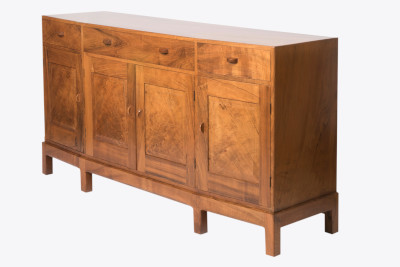
A fine example of this would be this be this stunning and rare walnut side cabinet, circa 1947. This could take pride of place in the hallway or dining room of a fabulous Cotswolds country home.
This impressive sideboard is slightly splayed to the front and set with four drawers above four doors. It is stamped Barnsley on the inside of left drawer and is priced at £12,500.
The drawers are compartmentalised and lined with green felt, so the owner would have kept valuable items in these drawers, the history of it is simply fascinating. I love to imagine what the owners would have used their commissioned furniture for! This piece was commissioned by J L Tankard. At the time Barnsley made a whole suite of furniture for his newly built house in the hills outside Skipton, including a dining suite, and a desk. We were able to purchase all the furniture from the family along with original drawings and literature between Barnsley and Mr Tankard.

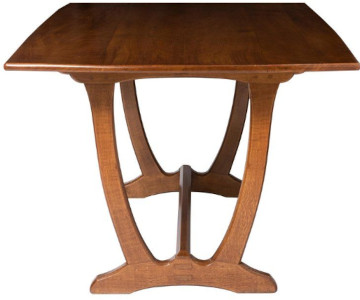
Another one of my favourite Cotswold examples is this oak refectory table on a “Wishbone” base circa 1940. It is just so unique and unusual in its design and I love the curved legs. It”s a classic piece that will remain timeless through the centuries. We have it valued at £8,000.

As the middle of the century approached, his workshop got larger and he produced more items. Edward developed his own style, combining his father”s influence with the elegant curves and fine inlay lines seen in the work of English furniture makers of the 18th century.
From the war years to the 1960″s, Barnsley was active in campaigns to secure the future of the crafts through the formation of the Crafts Centre and later the Crafts Council of Great Britain. He sat on lots of boards, and was a member of the 1955 advisory council for the V&A Museum.
During this time he was also an influential teacher at Loughborough college. His copious correspondence casts new light on the history of the twentieth century craft organisations and the debates around the tangled issues of the crafts, design, industry and education.
The workshop survived the difficult times of the depression and the war years keeping alive the spirit of the Arts and Crafts Movement. In 1955 when machinery was installed into the workshop, Edward had mixed feelings. He felt this removed the craftsman”s handwork that gave each piece its individuality and he believed it was important to acknowledge the contribution of the skilled maker to the success of a piece of furniture.
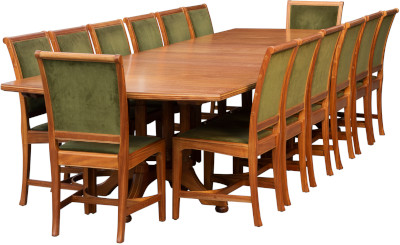
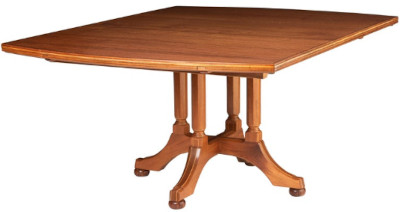
Pictured below, is an African mahogany extendable dining table, strung with holly and ebony, circa 1956.
It was made by Barnsley”s craftsmen Herbert Upton, George Taylor, Leal Wyatt and Oscar Dawson for the private dining room of the Appleby Frodingham steel works in Scunthorpe, 1956.
The detailing on this item is quite magnificent. As you will see the pedestals with four octagonal turned columns meet a quadripartite base joined by an X stretcher, on chamfered down swept legs and bun feet.
The matching set of 10 chairs feature original upholstery and are also crafted from African mahogany, again with holly and ebony stringing and curved front supports. This is valued at £14,000.
We have a collection of Barnsley pieces in stock varying in price from £3,000 up to £18,000. Considering the amount of work which goes into each of these items, the market value is reasonable. If you were to commission a piece from the workshop now, you would pay twice the amount of a vintage piece, furthermore the vintage items are made from timbers which you just won”t find on the market anymore.
Edward Barnsley really is one of the most influential figures of his time. Due to his sheer passion and dedication, his workshop survived through tough and precarious times. He was one of the only craftsmen of the era to appoint apprentices and pupils as he believed that without the accumulation and transfer of skills to younger people, there would be no foundation for the future revival of his trade.
Because of this, we can bear witness to a new blossoming of the arts and crafts movement in the 21st Century.
